
I bumped into an old colleague, our conversation brought a familiar, uncomfortable topic—one that hits far too close to home for me…
In the fast-paced world of international real estate sales, particularly when marketing Philippine properties to overseas investors, the operational engine behind the deal is just as critical as the deal itself. Yet, across the industry, a quiet friction persists between the front line and the back office.
Sales teams feel bogged down by administrative roadblocks, delayed commission releases, and fragmented communication. Meanwhile, support personnel—managing finance, compliance, and documentation—often view sales agents as erratic, demanding, or non-compliant. When support departments act as strict enforcement units rather than service partners, both sales force morale and the end-client experience suffer. Resolving this disconnect requires examining why this friction exists, how leadership inadvertently fosters it, and what it takes to build a unified operational culture.
Why Service Matters More Than Policing
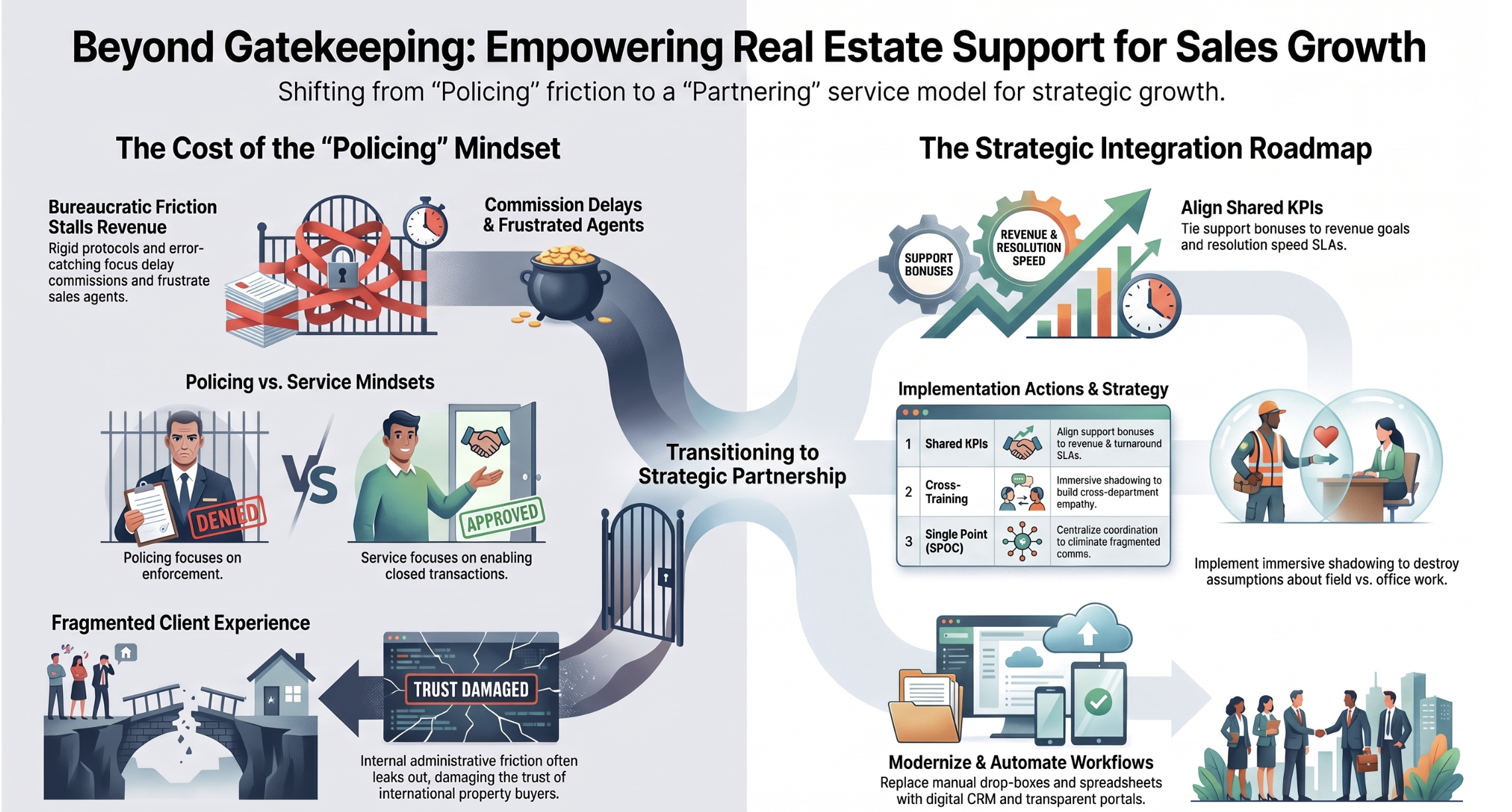
In a revenue-driven company, the primary objective of administrative, financial, and legal support is to enable closed transactions and deliver seamless post-sale execution. When support teams adopt a policing mindset, their focus shifts toward catching errors, enforcing rigid bureaucratic protocols, and halting processes over minor administrative gaps.
Conversely, when support operates with a service mindset:
Sales Morale and Productivity Skyrocket: Commission processing, incentive releases, and ledger reconciliations are handled with urgency and precision. Agents spend less time digging through archives or chasing missing payouts and more time acquiring clients and closing transactions.
Client Experience Flourishes: International property buyers expect seamless documentation, prompt payment tagging, and professional administrative follow-through. Internal friction directly leaks into the client experience when drop-box physical submissions sit uncollected or invoice guidelines remain conflicting across departments.
Root Causes: Why Support Groups Feel Indifferent or Resentful
The underlying tension between back-office support and front-line sales is rarely personal; it is structural. Several factors contribute to support team indifference or envy:
A. The “Second-Class Citizen” Trap (Organic vs. Contractual Hierarchy): In the Philippine real estate structure, a stark employment divide exists: back-office staff are organic, salaried employees with job security and permanent corporate status, while sellers and brokers are engaged on short-term contractual accreditations (typically 3 to 6 months) renewed purely on performance quotas. This structural gap creates an unspoken, toxic hierarchy. Organic support staff can develop an elitist mindset, viewing themselves as the “permanent stewards of the brand” while treating sellers as transient, disposable “outsiders.” Sellers are made to feel like second-class citizens in their own company. When back-office personnel view agents as temporary contractors, the motivation to deliver excellent service vanishes. Administrative compliance turns into an exercise of institutional leverage—where delayed taggings, uncollected drop-boxes, and ignored queries are used to signal power over the very people funding the company’s payroll.
B. The Compensation and Effort Perception Gap: Support personnel see the heavy lifting they do daily—auditing ledgers, verifying tax/VAT compliance, and managing complex cross-border documentation—while observing sales agents earn substantial commission payouts. Without visibility into the high-rejection environment, income volatility, and personal capital agents invest to build networks and close deals, back-office staff can easily perceive the dynamic as unfair: We do all the tedious labor, while they get all the financial rewards.
C. Lack of Field Awareness: Back-office teams operating within standard working hours and structured routines rarely witness the reality of field sales—navigating time zone differences, managing high-stakes buyer anxieties, or maintaining client relationships across multi-year build cycles. Without empathy for the external pressures sales agents face, administrative delays are often viewed internally as minor, even when they stall critical deal momentum.
D. Siloed Operations (The Left Hand Not Talking to the Right): When corporate teams operate in silos, administrative handoffs degrade. Conflicting directives from Finance, HR, and Operations regarding invoice submissions or incentive eligibility force agents into endless back-and-forth loops. This operational friction leads to fatigue on both sides, transforming standard verification into adversarial gatekeeping.
Why Leadership Teams Fail to Address the Rift
Executive leadership frequently acknowledges this tension but fails to resolve it permanently due to three systemic oversights:
- Misaligned Incentive Structures: Leadership praises sales teams for revenue generation while measuring support teams purely on risk mitigation, error avoidance, and cost control. When support is evaluated on what they prevent rather than what they enable, policing becomes their default defense mechanism.
- Treating Symptoms Instead of Root Causes: Management often intervenes only when an escalation reaches a tipping point—issuing temporary fixes or manual overrides rather than redesigning redundant processes, updating legacy systems, or establishing clear service-level agreements (SLAs).
- Designing for Bureaucracy Over Enabler Culture: In many legacy organizations, internal controls are layered on top of older controls without streamlining the underlying workflow. Support personnel are left managing broken processes, leaving them with little choice but to enforce rigid steps to protect themselves from corporate compliance audits.
Operational Roadmap: What Leadership Must Do Once and for All
To build an integrated, high-performing ecosystem where support functions serve as growth enablers, leadership must execute a decisive structural reset:
A. Re-align Key Performance Indicators (KPIs): Tie a portion of the support groups performance metrics directly to operational efficiency, resolution speed, and sales satisfaction scores. When back-office staff are incentivized based on how quickly and accurately commissions, allowances, and client taggings are processed, their orientation shifts from gatekeeping to actively problem-solving.
B. Dismantle the “Second-Class Citizen” Class Divide: Leadership must actively reset how the back office views the sales force:
- Reframing Internal Service: Establish a firm corporate policy that treats sellers as primary internal clients. Back-office staff exist because sellers bring in revenue, and sellers can only succeed when the back office enables them.
- Equalizing Access & Onboarding: Provide contractual sellers with equal access to digital tools, clear inquiry escalation paths, and professional administrative support. Include back-office staff in seller briefings so support teams witness the market pressure sellers navigate daily.
- Joint Recognition: Publicly reward support personnel who go above and beyond to clear administrative bottlenecks and expedite releases. Aligning back-office recognition with sales velocity destroys tenure-driven condescension.
C. Establish Centralized Points of Contact (SPOC): Eliminate multi-department confusion by designating dedicated liaison leads to handle finance, HR, and admin coordination for sales teams. Centralized communication channels eliminate conflicting directives, ensure single-threaded accountability, and provide a clear paper trail for complex reconciliations.
D. Build Mutual Field and Back-Office Awareness: Implement structured cross-functional shadowing. Have support specialists observe client onboarding and international sales briefings, and have sales leaders participate in back-office audit sessions. Mutual visibility destroys assumptions regarding who does the real work.
E. Modernize and Automate Admin Workflows: Transition away from manual, high-error processes—such as physical lobby drop-boxes, manual QR scanning, or fragmented email chains. Deploy digital submission portals with automated tracking, transparent status ledgers, and clear SLA notifications. Eliminating repetitive manual friction frees back-office personnel to focus on higher-value administrative support.
Conclusion
The Executive Reality Check: High-performing sellers are mobile. When a back office treats them like second-class contractors rather than essential growth partners, they don’t just complain—they migrate. They take their investor networks, market credibility, and transaction volume straight to developers who respect their hustle and support their deal velocity.
A real estate firm’s revenue engine does not run on sales strategy alone; it relies entirely on the strength and service orientation of its operational backbone. When executive leadership reframes back-office functions from administrative gatekeepers to proactive growth partners, internal friction dissolves.
Releasing commissions on time, maintaining transparent ledgers, collecting drop-box submissions promptly, and streamlining administrative support are not just routine backend tasks—they are core business drivers that directly power sales productivity, seller loyalty, and client trust.
Join the Conversation
How does your organization structure the relationship between front-line sales channels and back-office support? Have you experienced the “second-class citizen” dynamic in your operations, or found effective ways to build a seamless growth ecosystem?
Share your thoughts in the comments below, or connect with me directly to discuss custom frameworks for sales ecosystem engineering and channel alignment.
#RealEstateLeadership #RealEstateOperations #SalesEcosystem #ChannelManagement #OperationalExcellence #ThoughtLeadership
Comments are closed